
Prediction Markets Estimate Probability of U.S.–Cuba Conflict
How traders on major platforms are pricing the risk of a U.S.–Cuba confrontation.
March 21, 2026
Why Watch Prediction Markets on U.S.–Cuba Risk?
Prediction markets allow participants to trade on the probability of future events, including the risk of armed conflict. For U.S.–Cuba tensions, these markets can offer a real-time, aggregated view of how informed traders assess escalation risk—complementing traditional early warning indicators such as military posture, rhetoric, and diplomacy.
Analysts do not treat market prices as definitive forecasts. Instead, they compare them to other signals to understand where expectations are rising, falling, or diverging from expert assessments.
How Contracts on U.S.–Cuba Conflict Are Structured
Defining the Event
Conflict-related markets must specify what counts as a qualifying event. Contracts might be tied to a formal declaration of war, a defined threshold of military incidents, or a specific type of confrontation within a set time frame.
The wording matters enormously: a contract on “U.S. and Cuba in a state of declared war by year-end” is very different from one on “a significant military incident involving U.S. and Cuban forces.” Analysts reading prices always start by understanding the underlying definitions.
Time Frames and Rolling Horizons
Some markets focus on short horizons—such as the probability of a confrontation within the next three months—while others look farther ahead. Near-dated contracts tend to react more strongly to immediate developments; longer-dated ones capture views about structural risk and longer-run scenarios.
When prices on near-term and long-term contracts move in different directions, it can signal that traders see short-term de-escalation but continued structural tension, or vice versa.
Signals That Can Move U.S.–Cuba Conflict Markets
Military and Security Developments
Changes in U.S. naval posture in the Caribbean, new military exercises near the region, or reports of intelligence concerns can all influence how markets price conflict risk. Traders react both to official announcements and to credible open-source reporting.
Analysts cross-check these movements against our broader framework for early warning signals of war, which includes military buildup, alliance dynamics, and preparatory behavior.
Diplomatic and Economic Measures
Announcements about sanctions, diplomatic expulsions, or new talks can also move prices. A sharp deterioration in diplomatic ties may raise market-implied probabilities, while progress in dialogue or confidence-building measures may push them lower.
Traders also respond to third-party mediation efforts and broader regional developments that might either amplify or dampen tensions.
Interpreting Market-Implied Probabilities Carefully
What a 10–20% Range Really Means
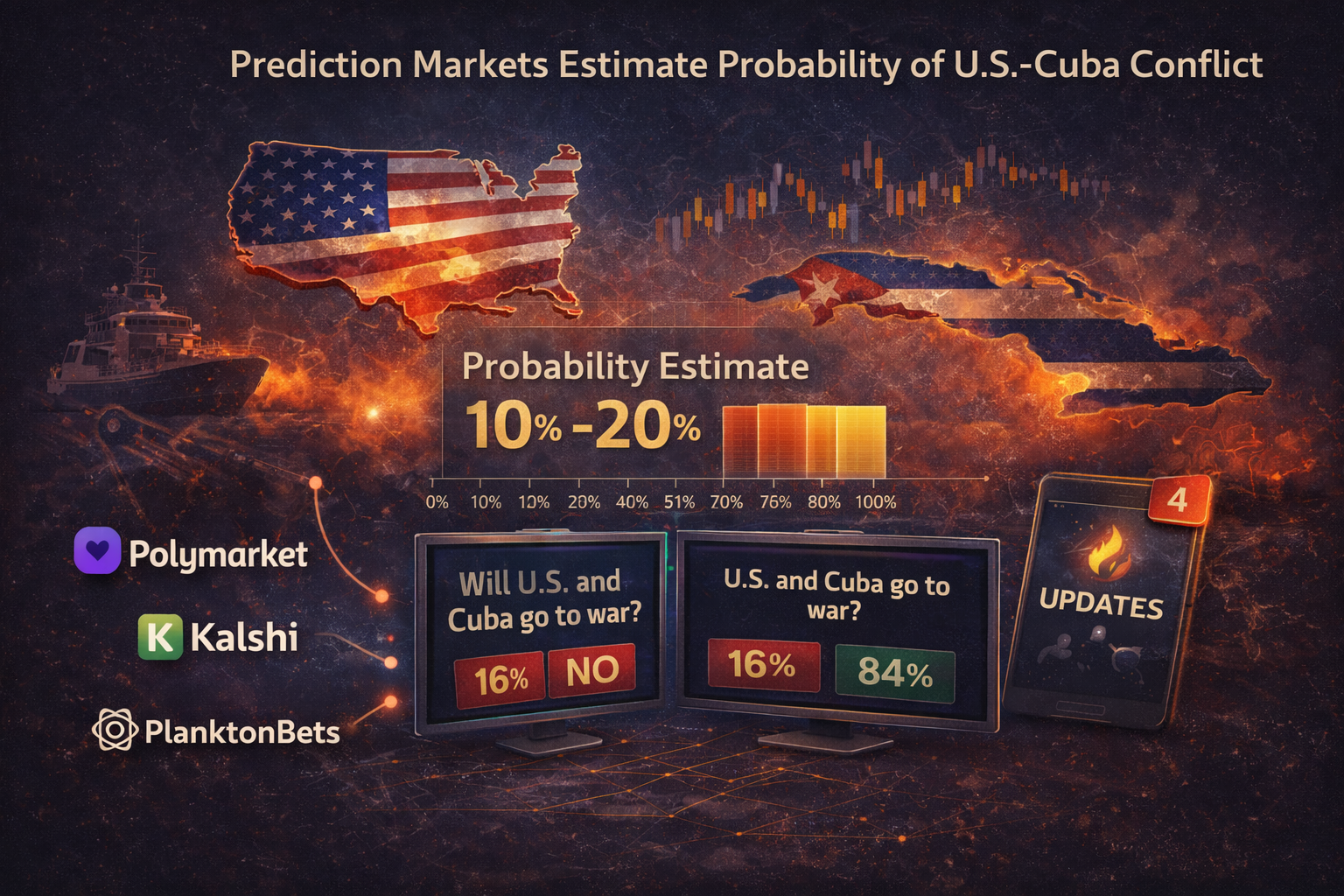
If markets imply, for example, a 10–20% probability of a defined U.S.–Cuba conflict scenario by a certain date, it does not mean that conflict is “likely,” nor that it can be ignored. Instead, it suggests that in a large number of comparable scenarios, such an outcome might occur in roughly one or two out of ten.
For policymakers and risk managers, these probabilities are often treated as triggers for contingency planning rather than predictions of inevitability.
Limits, Biases, and Ethical Concerns
Participation in conflict-related prediction markets may be geographically or demographically skewed. Liquidity can be thin, and prices can occasionally reflect speculation or hedging rather than pure information about conflict risk.
Ethical questions also arise when trading is tied to war outcomes. For these reasons, analysts generally use market prices as one input among many, comparing them with expert assessments, conflict risk indices, and qualitative scenario work.
How Analysts Use These Signals in Practice
Researchers tracking U.S.–Cuba risk often chart prediction market prices alongside other indicators: military deployments, diplomatic statements, sanctions, and domestic political developments. Divergences between markets and expert judgment can be informative, prompting closer review of assumptions on both sides.
For readers interested in methodology, see our deeper dive on how prediction markets forecast wars and our resources on conflict prediction analysis.
Related articles
10 Early Warning Signs of War Between Countries
Analysts monitor a set of recurring indicators that often appear before international conflicts escalate. Learn the key early warning signs of war between countries.
Military Buildup Indicators That Often Appear Before War
Troop deployments, exercises, and defense spending are among the strongest signals analysts use to assess conflict probability. Learn which military buildup indicators often appear before war.
Global Conflict Risk Index: Countries Most Likely to Face Conflict
A structured view of geopolitical risk by region. Which countries and regions analysts rank as most likely to face conflict, and what drives those assessments.