
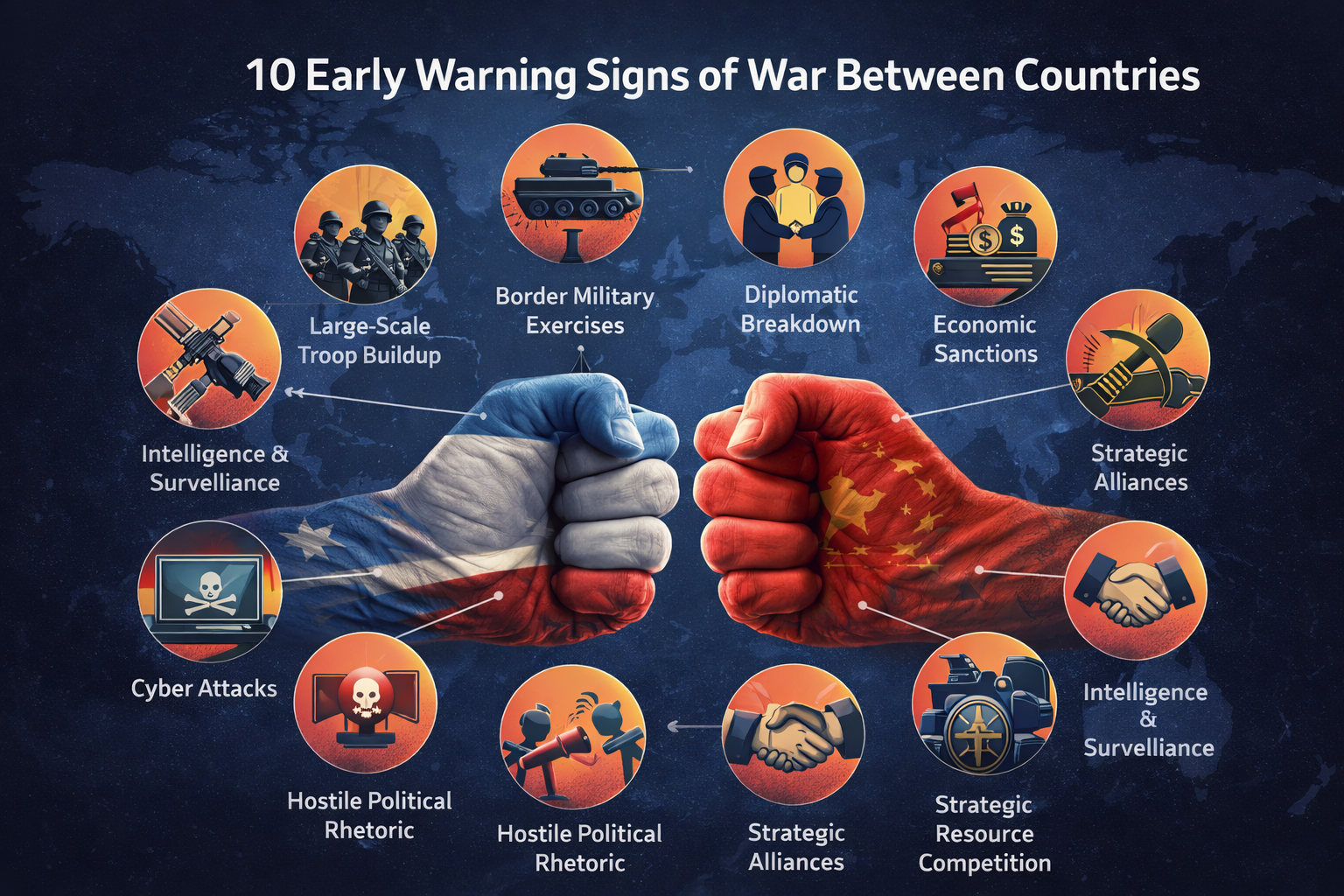
10 Early Warning Signs of War Between Countries
March 15, 2026
Introduction: Why Early Warning Signs Matter
Geopolitical conflicts rarely occur without warning. In many cases, early signals appear months or even years before tensions escalate into military confrontation. Analysts, researchers, and intelligence experts study these signals to estimate the probability of conflict and to identify which regions may face rising geopolitical risk.
Understanding early warning signs of war between countries helps policymakers, businesses, and the public prepare for potential instability. This article outlines ten indicators that analysts commonly monitor when assessing the risk of international conflict. For more on how these signals are used in practice, see our early warning signals page and geopolitical forecasting methods.
1. Military Buildup and Troop Movements
One of the strongest early warning signs of potential conflict is a significant increase in military presence near borders, disputed territories, or strategic locations. Large-scale troop deployments, mobilization of reserves, and the movement of heavy equipment often signal that a government is preparing for possible military action.
Analysts track troop concentrations, military exercises, and defense spending increases. When these indicators rise sharply and coincide with political tensions, the probability of conflict escalation is often assessed as higher.
2. Escalating Political Rhetoric
Hostile or inflammatory statements from political leaders can indicate deteriorating relations between countries. When official rhetoric shifts from diplomatic language to threats, ultimatums, or dehumanizing language, it often reflects—and can reinforce—a path toward confrontation.
Researchers monitor speeches, official statements, and state media to gauge whether rhetoric is escalating or de-escalating. Sustained hostile rhetoric is frequently one of the early warning signs analysts cite before conflicts.
3. Diplomatic Breakdown and Communication Failures
When diplomatic channels close, negotiations collapse, or high-level communication between governments stops, tensions can escalate quickly. Embassies may be recalled, ambassadors expelled, or dialogue suspended.
A breakdown in diplomacy removes tools for de-escalation and can signal that one or both sides are preparing for conflict rather than compromise. Analysts view the state of diplomatic relations as a key early warning indicator.
4. Economic Sanctions and Trade Restrictions
Economic pressure—including sanctions, trade embargoes, and financial restrictions—often increases before or during geopolitical crises. States may use economic measures to pressure adversaries or to prepare their own economies for conflict.
Rapid imposition of sanctions, severing of trade ties, or asset freezes can indicate that relations have deteriorated to a point where conflict is being seriously considered. Analysts combine economic indicators with political and military signals when assessing risk.
5. Propaganda and Information Warfare
Intensified propaganda, disinformation campaigns, and information warfare often precede or accompany military conflict. Governments may seek to justify future actions, rally domestic support, or undermine the legitimacy of adversaries.
Monitoring state media, social media campaigns, and official narratives helps analysts assess whether a country is preparing its population and international audience for possible conflict. This is among the early warning signs that have become more prominent in the digital age.
6. Alliance Shifts and New Security Pacts
New defense agreements, alliance formations, or shifts in security partnerships can alter the balance of power and signal that states are preparing for confrontation. Countries may seek security guarantees or commit to supporting allies in case of conflict.
Analysts track treaty signings, military cooperation agreements, and changes in alliance posture. These developments can both reflect and amplify geopolitical tensions and are often included in early warning assessments.
7. Domestic Mobilization and Nationalist Mobilization
Domestic mobilization—including nationalist rhetoric, conscription drives, or the glorification of military action—can indicate that a society is being prepared for conflict. When governments invest in rallying public support for confrontation, it often suggests that conflict is being seriously contemplated.
Researchers examine domestic political trends, media narratives, and public opinion to assess whether populations are being mobilized toward support for military action. This is one of the early warning signs that operates at the societal level.
8. Border Incidents and Low-Level Confrontations
Repeated border incidents, skirmishes, or low-level military confrontations can escalate into broader conflict. Even when individual events are small, a pattern of incidents may indicate that tensions are rising and that a larger confrontation is possible.
Analysts monitor ceasefire violations, border clashes, and naval or air encounters. An increase in the frequency or severity of such incidents is often treated as an early warning sign that conflict risk is rising.
9. Resource and Territorial Disputes Intensifying
Disputes over territory, resources, or strategic assets can become flashpoints for conflict. When negotiations over such issues stall, rhetoric hardens, or military posturing increases around disputed areas, the risk of escalation grows.
Territorial and resource disputes are well-documented drivers of conflict. Analysts track how these disputes evolve and whether they are being managed through dialogue or through pressure and military buildup.
10. Intelligence and Preparatory Measures
Governments often take preparatory measures before conflict—such as evacuating citizens, securing supply chains, or repositioning assets. Intelligence agencies may detect these measures through various means.
While not always public, indicators of preparation can be among the most telling early warning signs. Analysts combine open-source information with assessments of government behavior to identify when states are preparing for possible conflict.
Conclusion: Combining Signals for Better Forecasting
No single indicator is sufficient to predict conflict. Analysts combine military, diplomatic, economic, and political signals to estimate the probability of escalation. The ten early warning signs outlined here are among those most commonly used in geopolitical risk assessment.
Understanding these indicators helps readers interpret news and analysis with greater context. For more on how analysts use these signals in practice, explore our early warning signals page, conflict prediction analysis, and geopolitical forecasting methods.
Related articles
Military Buildup Indicators That Often Appear Before War
Troop deployments, exercises, and defense spending are among the strongest signals analysts use to assess conflict probability. Learn which military buildup indicators often appear before war.
Global Conflict Risk Index: Countries Most Likely to Face Conflict
A structured view of geopolitical risk by region. Which countries and regions analysts rank as most likely to face conflict, and what drives those assessments.
How Prediction Markets Forecast Wars
Prediction markets let participants trade on the probability of future events, including conflict. How they work, what they capture, and how analysts use them alongside other tools.