
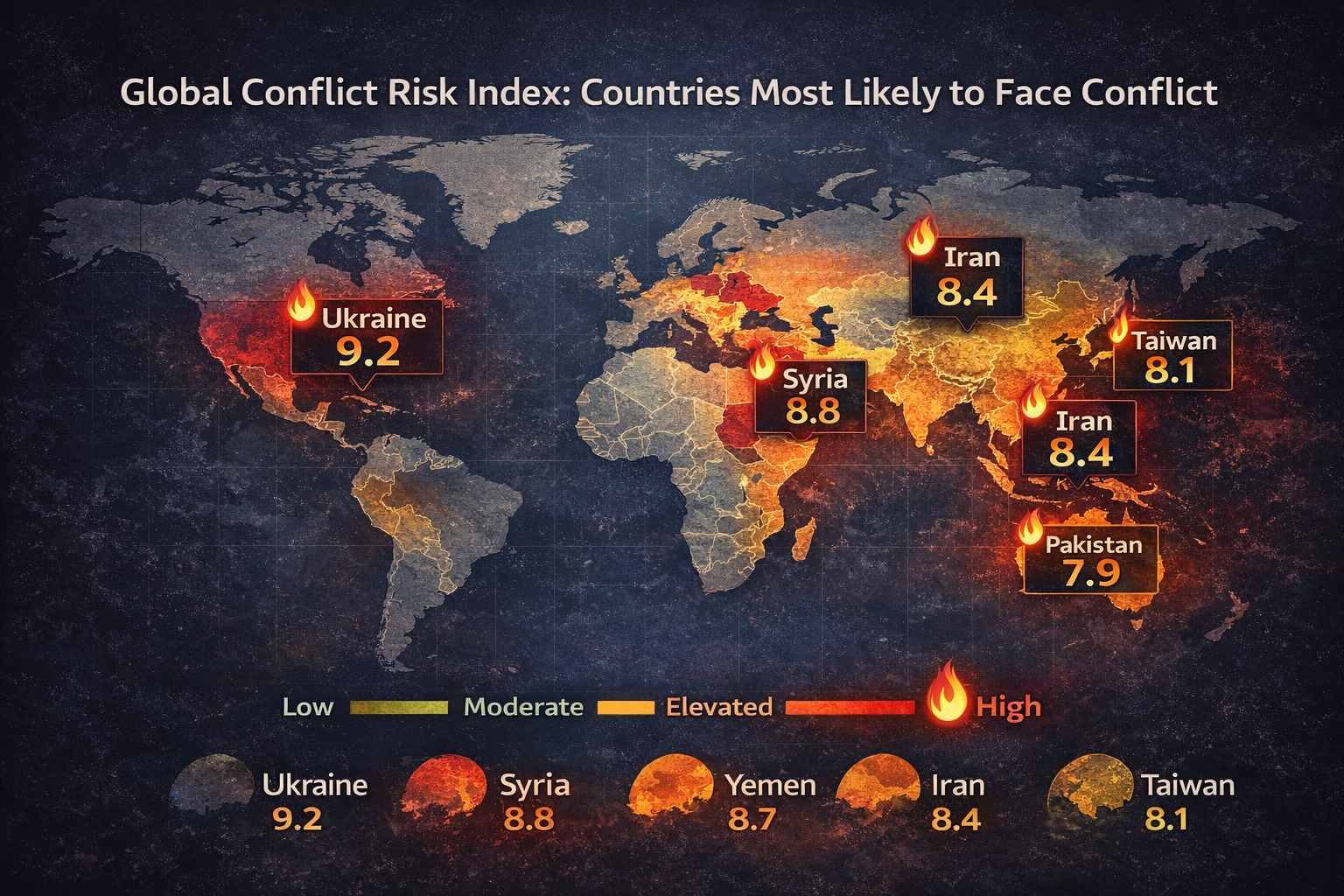
Global Conflict Risk Index: Countries Most Likely to Face Conflict
March 17, 2026
What Is a Global Conflict Risk Index?
A global conflict risk index is a structured framework that ranks countries or regions by their estimated probability of experiencing armed conflict, major geopolitical crisis, or significant escalation of tensions. Analysts use a combination of political, military, economic, and diplomatic indicators to produce these assessments.
This article explains how conflict risk indices work and outlines regions that frequently rank highly in such assessments. It is intended to help readers understand how analysts evaluate global conflict risk.
How Conflict Risk Indices Are Built
Conflict risk indices typically combine multiple data sources: historical conflict data, current political tensions, military posture, economic pressure, and the state of diplomatic relations. Some indices use quantitative models; others rely on expert judgment or a mix of both.
Indicators often include regime type, border disputes, ethnic or sectarian tensions, military spending, alliance structures, and recent incidents of violence or escalation. By aggregating these factors, analysts produce rankings or scores that allow comparison across countries and regions.
Regions Frequently Ranked High for Conflict Risk
Certain regions appear consistently in high-risk categories due to ongoing conflicts, historical tensions, or structural factors that make escalation more likely. The following overview reflects patterns commonly cited in conflict risk analysis; specific rankings vary by source and methodology.
Eastern Europe and the Former Soviet Space
The war in Ukraine and tensions between Russia and NATO have placed Eastern Europe at the center of conflict risk assessments. Military deployments, alliance dynamics, and the evolution of the conflict in Ukraine are closely monitored. Countries bordering Russia or Ukraine often rank highly in conflict risk indices.
The Middle East
The Middle East remains one of the most complex regions for conflict forecasting. Rivalries between regional powers, proxy conflicts, territorial disputes, and nuclear proliferation concerns contribute to elevated risk rankings. Analysts track multiple flashpoints, including Israel–Iran tensions, Gulf dynamics, and instability in Syria, Iraq, and Yemen.
East Asia and the Taiwan Strait
East Asia is a focus for conflict risk due to tensions over Taiwan, territorial disputes in the South and East China Seas, and North Korean nuclear and missile activity. Military exercises, naval patrols, and political rhetoric are monitored to assess the probability of escalation. Several East Asian flashpoints frequently appear in global conflict risk indices.
South Asia
Pakistan–India tensions, centered on Kashmir and the Line of Control, and Pakistan–Afghanistan border and security dynamics contribute to elevated risk rankings for South Asia. Nuclear capabilities in the region add to the stakes. Conflict risk indices often rank one or more South Asian states highly.
Africa: Hotspots and Instability
Several African countries face ongoing conflict or high instability due to insurgencies, ethnic tensions, governance failures, and external involvement. Conflict risk indices typically highlight the Sahel, the Horn of Africa, and other regions where violence is persistent or escalating.
What Drives High Risk Scores?
High conflict risk scores are usually driven by a combination of factors: active or recent conflict, military buildup, diplomatic breakdown, economic pressure, territorial disputes, and weak institutions. No single factor determines a country's ranking; analysts weigh multiple indicators.
Understanding the drivers of risk helps readers interpret why certain countries or regions appear in conflict risk indices and how conditions might change over time.
Limitations of Conflict Risk Indices
Conflict risk indices are useful for comparison and awareness but have limitations. They cannot predict exactly when or where conflict will occur; they estimate relative risk based on available data and assumptions. Surprise events, leadership decisions, and diplomatic breakthroughs can alter trajectories quickly.
Readers should treat indices as one input among many when forming views on global security. For deeper analysis on specific regions, see our trending conflicts and early warning signals resources.
Conclusion: Using Risk Indices Responsibly
A global conflict risk index helps summarize where geopolitical tensions are highest and which countries are most likely to face conflict according to current indicators. By understanding how these indices are built and what drives high rankings, readers can better interpret geopolitical news and analysis.
For more on how analysts monitor risk in practice, explore our Global Risk Index and early warning signals pages, plus conflict prediction analysis.
Related articles
10 Early Warning Signs of War Between Countries
Analysts monitor a set of recurring indicators that often appear before international conflicts escalate. Learn the key early warning signs of war between countries.
Military Buildup Indicators That Often Appear Before War
Troop deployments, exercises, and defense spending are among the strongest signals analysts use to assess conflict probability. Learn which military buildup indicators often appear before war.
How Prediction Markets Forecast Wars
Prediction markets let participants trade on the probability of future events, including conflict. How they work, what they capture, and how analysts use them alongside other tools.