
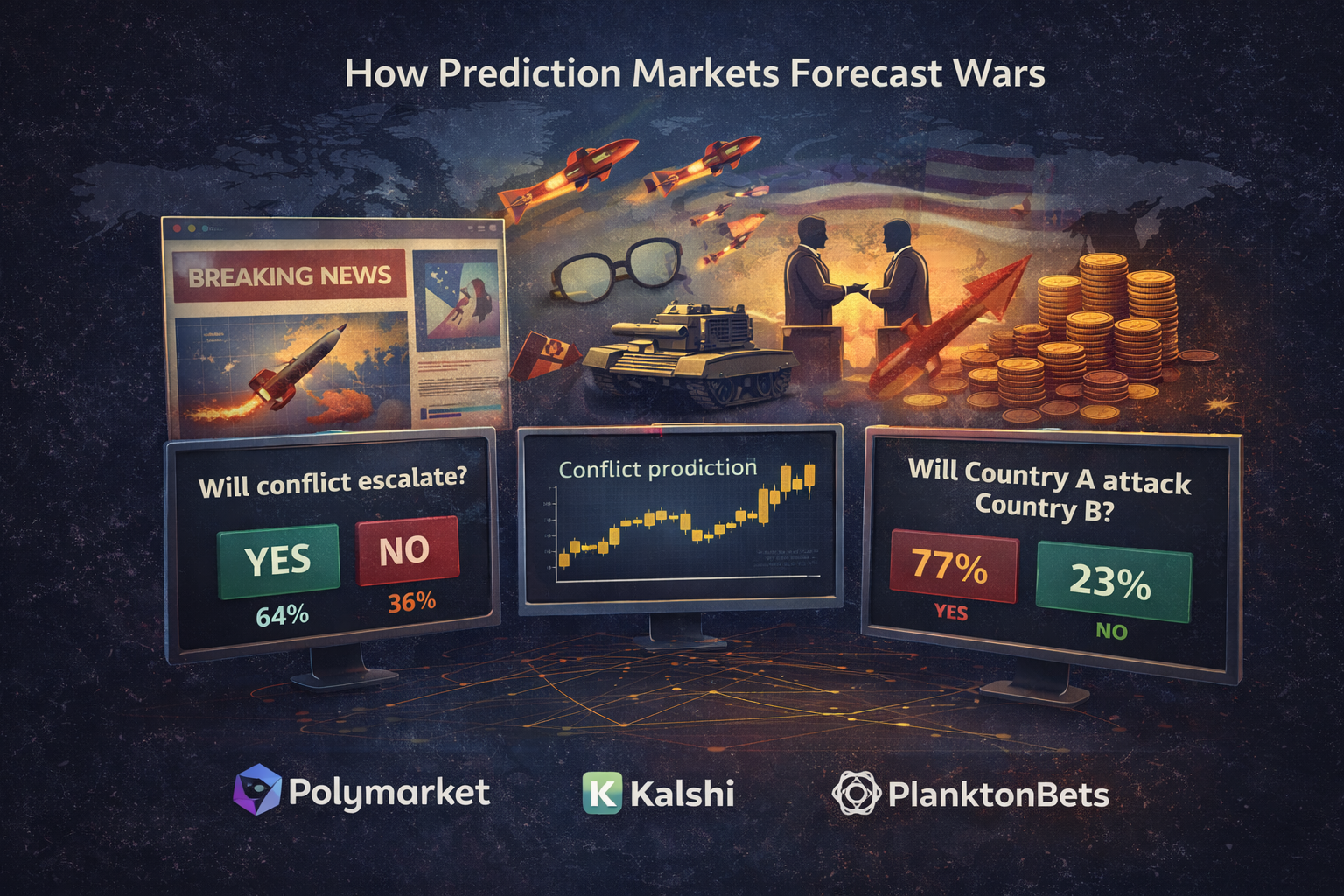
How Prediction Markets Forecast Wars
March 18, 2026
What Are Prediction Markets?
Prediction markets are platforms where participants can trade contracts whose payouts depend on the outcome of future events. If an event occurs, the contract pays out; if not, it expires worthless. Prices in these markets are often interpreted as the collective probability that the event will occur—for example, the probability that a conflict will escalate or that a ceasefire will hold.
This article explains how prediction markets are used in the context of geopolitical forecasting and conflict prediction, and how analysts interpret their signals.
How Prediction Markets Produce Probability Estimates
In a typical prediction market, participants buy and sell shares tied to a specific outcome. As new information emerges—such as diplomatic developments, military activity, or economic sanctions—participants may update their views and trade accordingly. Prices move until supply and demand balance, at which point the market price is often described as the "implied probability" of the event.
For conflict-related markets, participants might trade on questions such as: Will country A and country B be in a state of declared war by a certain date? Will there be a major military incident in region X? Will a specific ceasefire hold? The resulting prices are cited by some analysts as one measure of how informed participants view the likelihood of these outcomes.
Advantages of Prediction Markets in Conflict Forecasting
Proponents of prediction markets argue that they aggregate information from many participants quickly. People with relevant knowledge or analysis may trade on their views, and the market price can reflect a blend of those perspectives. In theory, this can produce probability estimates that incorporate diverse information and update rapidly when news breaks.
Prediction markets are also transparent in the sense that prices are visible and change in real time. Analysts can observe how expectations shift in response to diplomatic statements, military developments, or other events. This makes them a useful complement to traditional intelligence and expert judgment for some researchers and commentators.
Limitations and Critiques
Prediction markets have important limitations. Participation may be limited or skewed toward certain demographics or regions, which can bias prices. Markets can be influenced by speculation, manipulation, or liquidity constraints rather than pure information about conflict probability.
Ethical concerns also arise when markets are tied to grave events such as war or humanitarian crises. Critics argue that profiting from predictions about conflict can create perverse incentives or appear insensitive. Regulators in some jurisdictions restrict or prohibit such markets.
For these reasons, most analysts treat prediction market prices as one signal among many—not as definitive forecasts. They are best used alongside military, diplomatic, and economic indicators rather than in isolation.
How Analysts Use Prediction Markets
Analysts who follow geopolitical risk often use prediction markets as a supplementary tool. When market-implied probabilities rise or fall sharply, it can prompt further investigation: What news or analysis might have driven the shift? How does this compare to expert assessments or model-based forecasts?
Comparing prediction market prices to other sources—such as expert surveys, conflict risk indices, or scenario analysis—helps analysts identify consensus or divergence in expectations. This comparative approach is common in research and policy discussion.
Examples of Conflict-Related Prediction Markets
Several platforms offer or have offered markets on geopolitical events, including conflict escalation, ceasefire durability, and political outcomes in conflict-affected regions. The availability and legality of such markets vary by jurisdiction. Names often cited in discussions of geopolitical forecasting include Polymarket, Kalshi, and other prediction market platforms.
The specific markets available change over time. Readers interested in how these platforms work can look at their official documentation and terms of use, and should be aware of regulatory and ethical considerations in their region.
Conclusion: Prediction Markets as One Tool Among Many
Prediction markets can provide a real-time view of how participants are pricing the probability of conflict-related events. They are useful for awareness and comparison but should not be treated as authoritative forecasts. Analysts typically combine prediction market signals with military, diplomatic, and economic indicators to form a more complete picture of geopolitical risk.
For more on how forecasting works in practice, see our resources on early warning signs, the global conflict risk index, and geopolitical forecasting methods.
Related articles
10 Early Warning Signs of War Between Countries
Analysts monitor a set of recurring indicators that often appear before international conflicts escalate. Learn the key early warning signs of war between countries.
Military Buildup Indicators That Often Appear Before War
Troop deployments, exercises, and defense spending are among the strongest signals analysts use to assess conflict probability. Learn which military buildup indicators often appear before war.
Global Conflict Risk Index: Countries Most Likely to Face Conflict
A structured view of geopolitical risk by region. Which countries and regions analysts rank as most likely to face conflict, and what drives those assessments.