
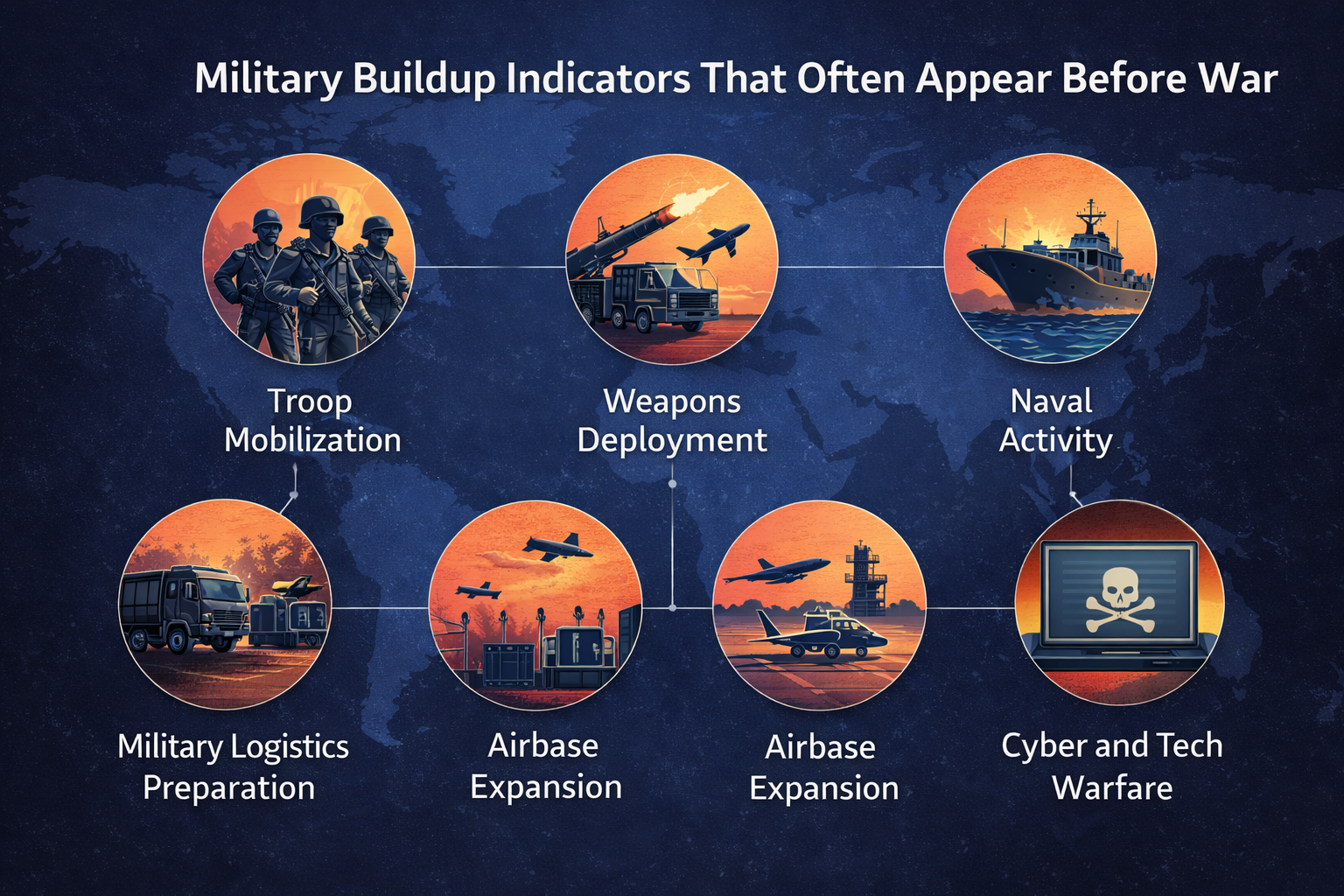
Military Buildup Indicators That Often Appear Before War
March 16, 2026
Why Military Buildup Matters in Conflict Forecasting
Military developments are among the most closely watched indicators in geopolitical forecasting. Analysts monitor troop movements, military exercises, defense spending, and weapons deployments to assess whether tensions are rising and whether countries are preparing for possible conflict.
This article outlines the military buildup indicators that frequently appear before wars or major confrontations. Understanding these signals helps readers interpret how analysts estimate conflict probability. For related analysis, see our global conflict risk index and early warning signals of war.
Large-Scale Troop Deployments
One of the most significant military buildup indicators is the large-scale deployment of troops to border regions, disputed territories, or areas of strategic importance. Historical conflicts have often been preceded by concentrations of forces that exceeded normal peacetime levels.
Analysts track the number of troops, the type of units, and the duration of deployments. Sustained or growing troop concentrations near potential flashpoints are often cited as early warning signs of possible conflict. Satellite imagery, official announcements, and open-source reporting are used to monitor these developments.
Military Exercises and Readiness Drills
Military exercises can serve both defensive and offensive purposes. While many exercises are routine, unusually large, frequent, or realistic exercises—especially near borders or in contested areas—can signal preparation for conflict.
Analysts distinguish between routine training and exercises that simulate invasion, mobilization, or offensive operations. The scale, location, and scenario of exercises are key factors in assessing whether they represent a military buildup indicator that may precede conflict.
Defense Spending and Procurement Surges
Rapid increases in defense spending, emergency procurement of weapons or supplies, and the acceleration of military modernization programs can indicate that a country is preparing for possible conflict. Budget shifts often precede or accompany troop movements and exercises.
Researchers monitor national budgets, arms deals, and defense industry activity. A sudden or sustained surge in military investment is one of the military buildup indicators that analysts use when evaluating conflict risk.
Mobilization of Reserves and Conscription
When countries call up reserves, extend conscription, or expand military recruitment, it often signals preparation for sustained conflict. Mobilization is costly and disruptive, so governments typically take this step only when they consider conflict likely or imminent.
Analysts track mobilization announcements, reserve call-ups, and changes in conscription policy. These measures are among the most serious military buildup indicators because they indicate that a state is preparing its full military capacity.
Naval and Air Force Posturing
Naval deployments, increased air patrols, and the positioning of ships and aircraft near contested waters or borders can signal rising tensions. Naval blockades, increased submarine activity, or airspace violations often appear in the run-up to or during crises.
Maritime and air domains are particularly important in regions with territorial disputes or strategic chokepoints. Analysts monitor fleet movements, flight patterns, and incidents at sea or in the air as part of military buildup assessment.
Logistics and Supply Chain Preparation
Military conflict requires extensive logistics—fuel, ammunition, medical support, and supply lines. The prepositioning of supplies, construction of forward bases, and expansion of logistics networks can indicate that a country is preparing for sustained operations.
While less visible than troop deployments, logistics buildup is a critical military indicator. Analysts use open-source data and satellite imagery to assess supply depots, transport activity, and infrastructure development in conflict-prone regions.
Historical Patterns and Comparative Analysis
Researchers study past conflicts to identify which military buildup indicators were present before escalation. Comparative analysis helps distinguish routine military activity from patterns that have historically preceded war.
By combining historical research with real-time monitoring, analysts aim to improve the accuracy of conflict forecasts. Military buildup indicators are most useful when interpreted in context with diplomatic, economic, and political developments.
Conclusion: Integrating Military Indicators Into Risk Assessment
Military buildup indicators are central to geopolitical conflict forecasting. Troop deployments, exercises, defense spending, mobilization, and naval and air posturing are among the signals that analysts monitor to estimate the probability of conflict.
No single indicator is definitive; analysts combine military data with diplomatic, economic, and political indicators to build a fuller picture of risk. For more on how these signals are used in practice, see our early warning signs page, the global conflict risk index, and geopolitical forecasting resources.
Related articles
10 Early Warning Signs of War Between Countries
Analysts monitor a set of recurring indicators that often appear before international conflicts escalate. Learn the key early warning signs of war between countries.
Global Conflict Risk Index: Countries Most Likely to Face Conflict
A structured view of geopolitical risk by region. Which countries and regions analysts rank as most likely to face conflict, and what drives those assessments.
How Prediction Markets Forecast Wars
Prediction markets let participants trade on the probability of future events, including conflict. How they work, what they capture, and how analysts use them alongside other tools.