
When Will the US–Israel–Iran War End?
Scenarios and indicators analysts watch when assessing how long a US–Israel–Iran conflict might last.
March 22, 2026
Why “When Will the War End?” Is So Hard to Answer
When conflict escalates between the US, Israel, and Iran, one of the most urgent questions for policymakers and the public is how long the confrontation might last. Wars can end through decisive victory, negotiated settlement, or gradual exhaustion—and forecasting which path will dominate is inherently uncertain.
Rather than predicting a single end date, analysts think in terms of scenarios and conditional probabilities. They ask what combination of military, diplomatic, and domestic political factors would make an end to large-scale hostilities more or less likely over the next months and years.
From Ceasefire to Settlement
Ceasefires as Milestones, Not Endpoints
Our analysis of when a ceasefire might happen in the US–Israel–Iran war emphasizes that ceasefires are important waypoints but not guaranteed endpoints. Many conflicts experience cycles of ceasefire, violation, and renewed escalation before any durable settlement is reached.
When assessing when a war might “end,” analysts distinguish between a reduction in major hostilities and the conclusion of a political agreement that addresses core grievances.
Conditions for Durable De-escalation
For a conflict involving the US, Israel, and Iran, several conditions would typically need to move in the right direction for a long-term settlement:
- Clear incentives on all sides to avoid further escalation. - Mechanisms to monitor and verify compliance with agreements. - Regional and international actors willing to support and guarantee elements of a deal.
The speed at which these conditions evolve is one of the main drivers of forecasts about when the war could end.
Indicators Analysts Watch When Evaluating Timelines
Military Trajectory and Costs
Analysts track battlefield dynamics, casualty trends, and the rate of high-intensity operations. If major actors see diminishing returns from continued fighting—or fear unacceptable escalation risks—they may become more open to compromise.
Conversely, actors who believe they are gaining ground may resist negotiations, extending the expected duration of the conflict.
Diplomatic Engagement and Mediation Efforts
Sustained diplomatic engagement is often a prerequisite for ending wars that involve multiple powerful actors. Shuttle diplomacy, multilateral talks, and the appointment of credible mediators can all signal that serious efforts are under way to move beyond short-term ceasefires.
Analysts monitor how often senior officials meet, whether negotiation agendas broaden beyond immediate security concerns, and whether previously red-line issues begin to see creative proposals.
Domestic Political Constraints
Changes in leadership, elections, coalition politics, and public opinion can either unlock compromise or harden positions. Conflict timelines can lengthen when leaders are constrained by domestic audiences that strongly oppose concessions, or shorten when political incentives favor de-escalation.
Role of Prediction Markets and Risk Models
Market-Implied Timelines
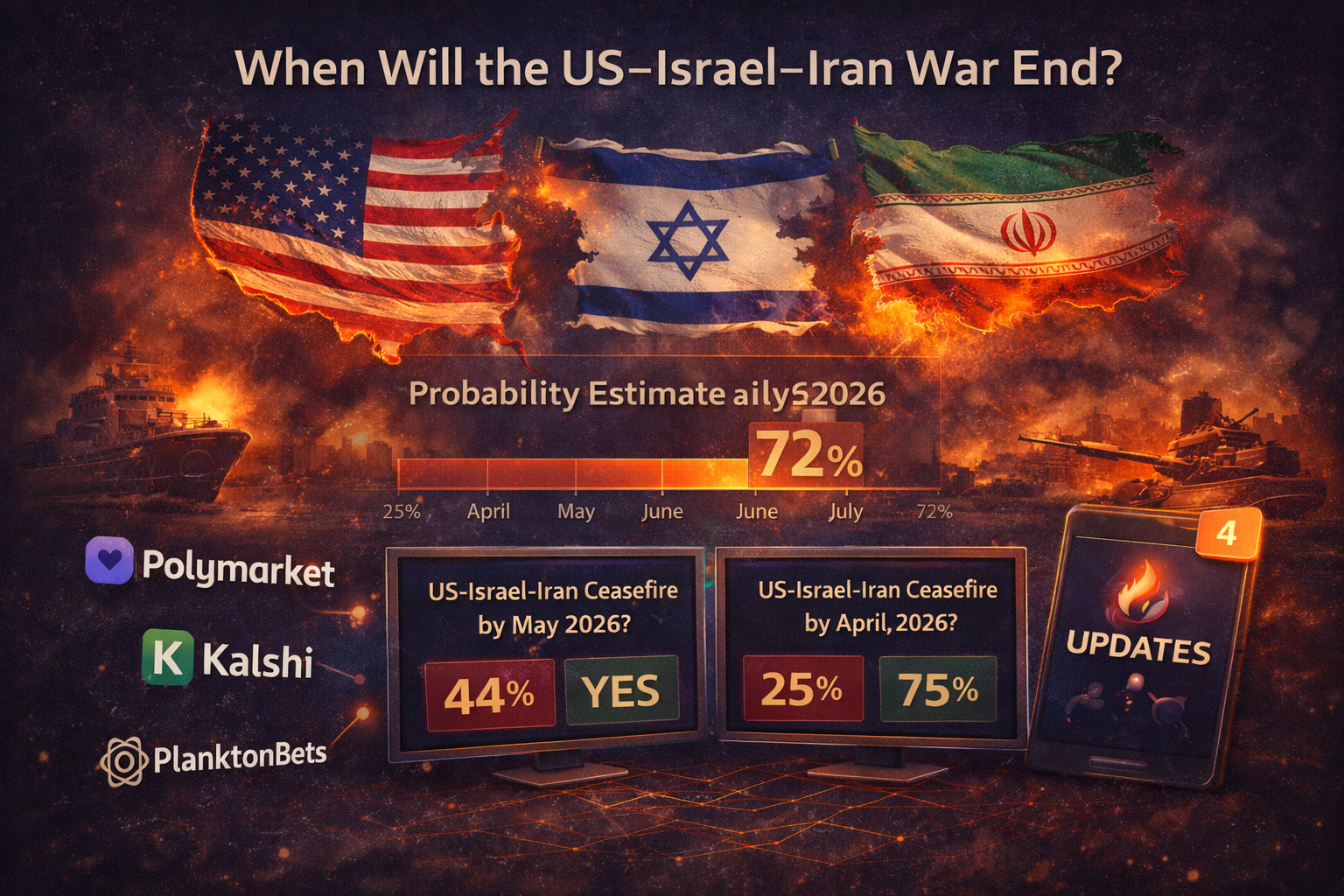
In some cases, prediction markets list contracts tied to the timing of ceasefires or broader settlements. While such contracts are not available for every conflict, when they exist they can provide a rough sense of how participants price near-term versus longer-term resolution.
Analysts treat these prices as one signal alongside model-based estimates and expert surveys. Sharp changes can highlight moments when expectations about the war’s trajectory are shifting quickly.
Structural Conflict Risk
Long-run models and global conflict risk index–style frameworks focus on deeper drivers of instability: alliance structures, regional rivalries, governance quality, and economic pressures. These factors influence whether a settlement, once reached, is likely to hold or to break down into renewed violence.
High structural risk does not preclude an end to active fighting, but it can mean that forecasts about “the end of the war” must be made with particular caution.
How to Interpret Timelines Responsibly
Embracing Uncertainty
Responsible forecasting emphasizes uncertainty rather than overconfident point predictions. Analysts often communicate ranges of possible timelines—such as higher probability of significant de-escalation within one to two years—conditioned on specific assumptions about diplomacy and domestic politics.
Scenario planning helps decision-makers prepare for longer wars even when they hope for faster resolution.
Focusing on Actionable Signals
Instead of fixating on a specific end date, forecasters highlight the signals that would meaningfully change their expectations: breakthroughs in negotiations, major shifts in alliance behavior, changes in domestic political incentives, or unexpected escalations.
By tracking these indicators, policymakers and observers can update their views as the conflict evolves, rather than anchoring on a single forecast.
Conclusion: Watching the Path, Not Just the Destination
The question “When will the US–Israel–Iran war end?” does not have a fixed answer. What analysts can offer is a structured way of thinking about timelines, scenarios, and the signals that make earlier or later endings more plausible.
Combining early warning indicators, diplomatic monitoring, prediction markets, and structural risk analysis helps build a more nuanced view of how the conflict might evolve—and what steps could make a sustainable end more likely.
Related articles
When Will a Ceasefire Happen in the US–Israel–Iran War?
Prediction markets and conflict indicators offer one lens on when a ceasefire between the US, Israel, and Iran could emerge—and what signals might warn that negotiations are stalling.
How Prediction Markets Forecast Wars
Prediction markets let participants trade on the probability of future events, including conflict. How they work, what they capture, and how analysts use them alongside other tools.
Prediction Markets Estimate Probability of U.S.–Cuba Conflict
How prediction markets are pricing the probability of a U.S.–Cuba conflict, and how analysts interpret those signals alongside traditional early warning indicators.